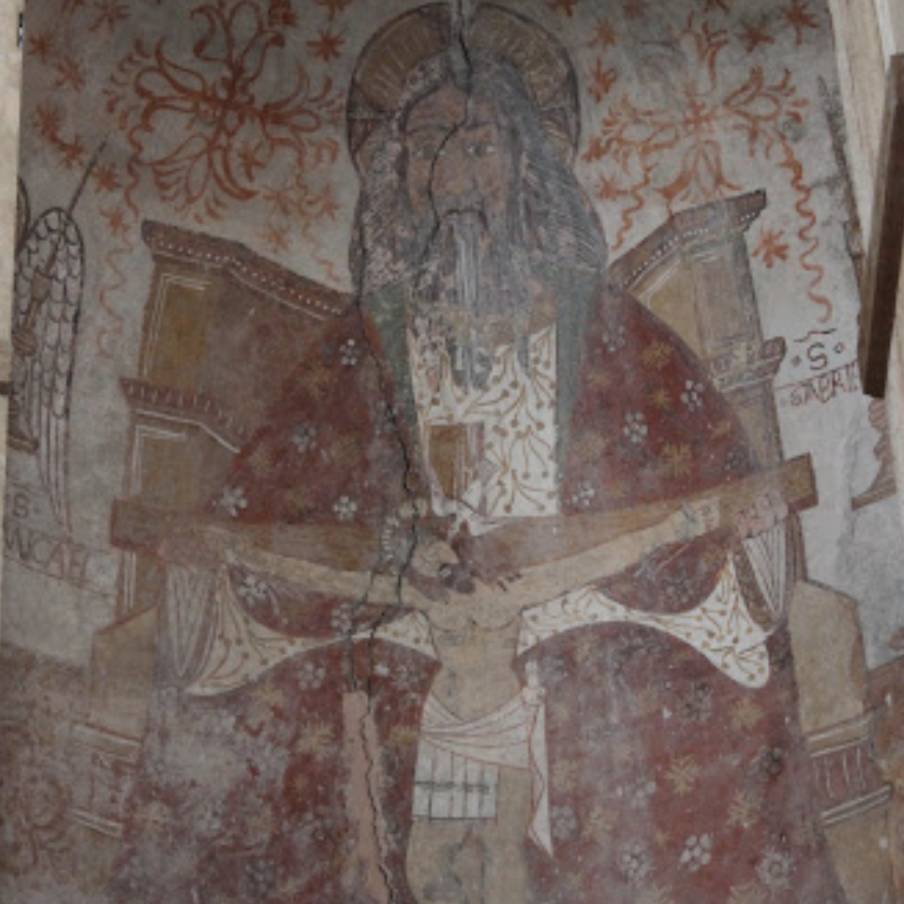
Raised with a single nave, it was originally an integral part of a Basilian monastery of the same name. In 1510 it was elevated to parish status. The fresco inside depicts the Trinity, with God Father in the center holding the crucified Christ, surrounded above by the archangels Michael, Gabriel, Raphael, and Uriel. The painting was executed in 1521 and commissioned by Rinaldo Grisolia, who had provided for the reconstruction of the building damaged by a landslide or a earthquake. The extraordinariness of the fresco lies in the archangel Gabriel portrayed with a brown face and disc-shaped halo. This suggests the commissioner's membership to the Trinitarian order, dedicated to the ransom of Christians enslaved by the Turkish-Barbarians. A task made complex and delicate because of the dialogue started and concluded with the Islamists, and which could be successful thanks to the mediator's talents. The Moorish semblance of the archangel Gabriel must have meant, for Grisolia, that God, through him, in all successfully resolved cases had announced to the Muslims his willingness to release the slave under negotiation. Gabriel, in fact, is recognized not only by Christian theology as the angel-announcer to Mary of the motherhood of Christ, but also by the Islamic religion, having appeared in a dream to Muhammad foretelling him of the writing of the Qur’an. (Edited by Xavier Napolitano)
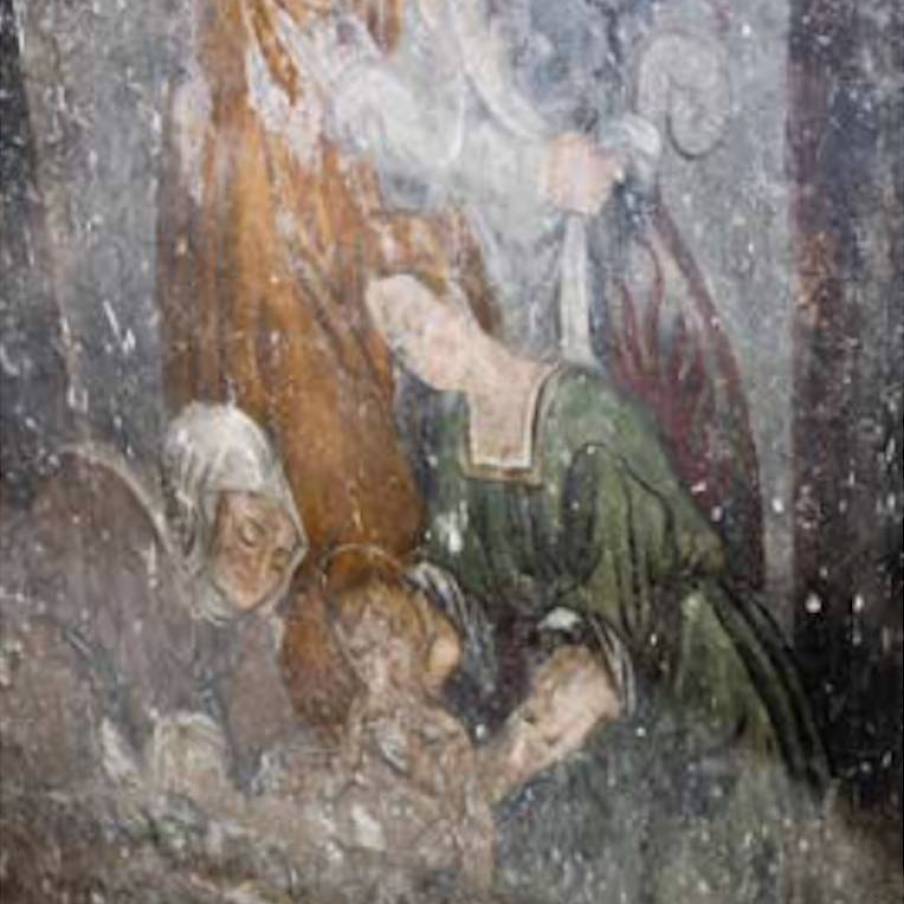
Set up as a square hall presumably between the seventeenth and eighteenth centuries, it is not excluded that it was originally dedicated to St. John and accorsed on his feast day (June 24) for auspicious rites to parturients and lustral rites to infants with survival difficulties, carried out in the crypt revealed by the restorations of the 1980s after the expansion of the cemetery. The fresco preserved there, inscribed in a lunette, was revealed in its wholeness in the course of the mentioned works. Proposing the iconographic canon of the birth of the Baptist, it shows a woman who has just given birth, flanked by the midwife bending over the lifeless-looking infant whom she immerses in a basin of water, while two other standing women wait to dry him. At the bottom is the year of execution - 1705 - changed to 1905 to make it coincide with the year the cemetery was built, when the crypt was buried by covering the lower half of the fresco to erase the memory of the lustral rites. The upper half was spared with the woman on the bed recognized as St. Anne, traditionally invoked by the dying, therefore naming the small church after her in order to make the painting congruent with the cemetery area. (Edited by Xavier Napolitano)
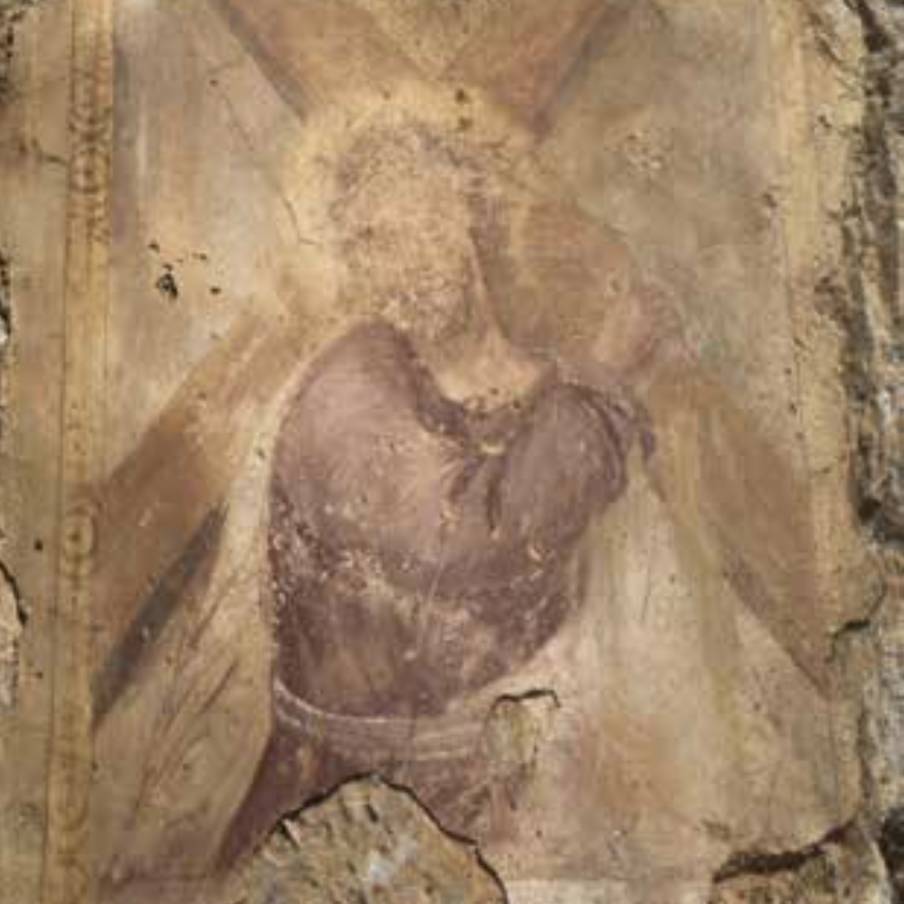
The fresco depicts Christ holding the Cross, made in the mid-18th century by an unknown author, had an auspicious and protective function for the wayfarers who walked the path.
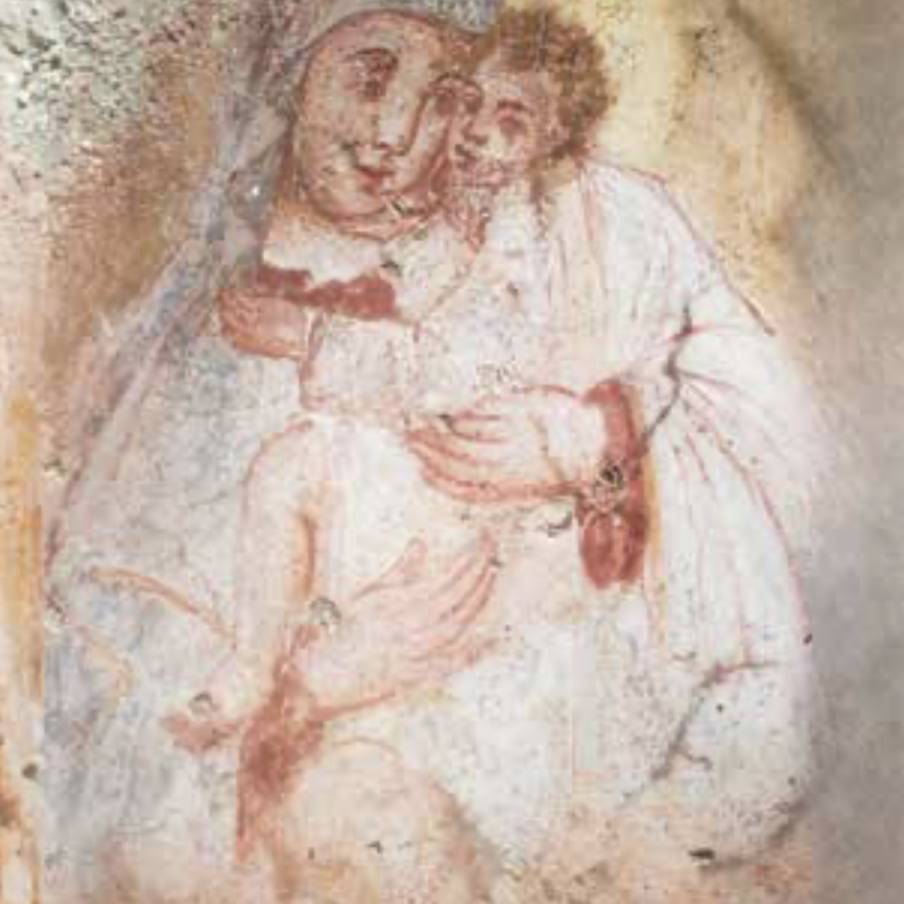
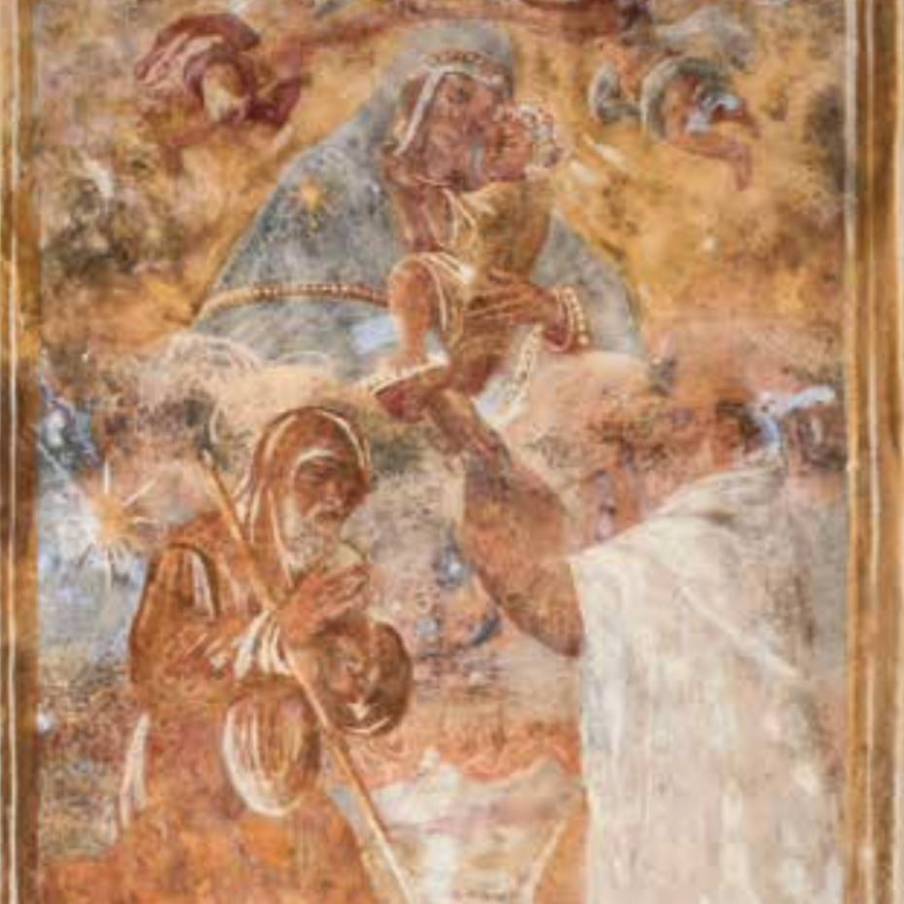
The fresco depicts Our Lady and Christ child’s faces; made in the mid-18th century by an unknown author, had an auspicious function for wayfarers who entrusted themselves to Our Lady.
Rectangular in shape with a small porch, it dates f back to the 18th century. It is representative of the sacralization of rural areas promoted by Counter-Reformation religiosity and of processional rites for propitiatory and penitential purposes having as their destinations churches outside the city walls. The devotion to Our Lady of Mount Carmel was accentuated in the Kingdom of Naples after Masaniello's revolution (1647-1648), whose episodes of the most acute tension, had as their epicenter the church and piazza del Carmine in Naples. Our Lady was therefore recognized as the propitiator and guardian of social peace and the one who could undermine class conflicts. In the fresco preserved here, dated 1724, work of Mormannese artist Angelo Galtieri, the named after Madonna is represented between St. Francis of Paola and St. Simon Stock, protector of the Carmelite Order. (Edited by Xavier Napolitano)
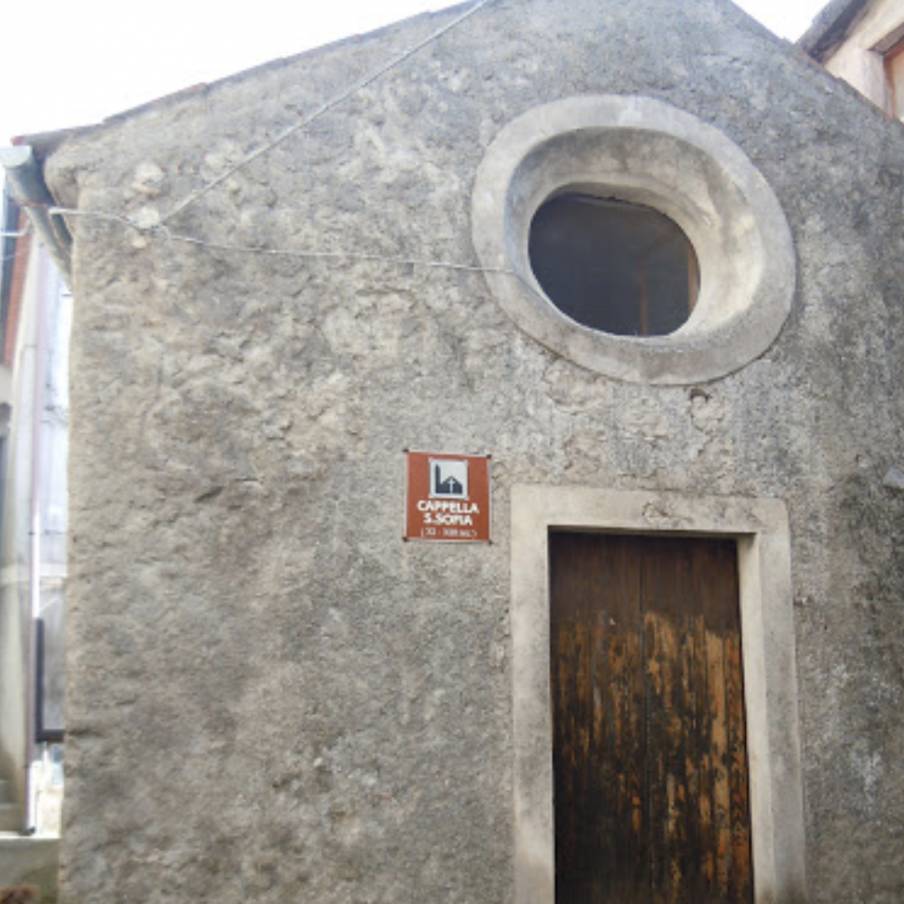
Square hall shrine datable to the 11th-13th centuries, at the time of the Italo-Greek monks venerating the Divine Wisdom. From 1504 it was the headquarter of the Mount of Mercy founded by the Papasiderese Franceschino Forestiero with the purpose of distributing free grain to the poor. There, he commissioned the frescoes of the Pieta and Ss. Apollonia, Catherine, Lucy, Peter and Paul. Upon his death, the charitable work was continued by a family member of the same name, who, in 1569, decided to add the images of SS. Rocco and Blaise. In 1593 the bishop of Cassano validated the establishment, in a contiguous location to the chapel but with other purposes, of the new Mount of Mercy. After the plague of 1656, the frescoes of the Virgin of Constantinople Enthroned and St. Sophia, are due to the patrician fellow citizen Florena Mastrota. With these works, the chapel's link with Mercurian monasticism was recomposed and the ideal continuity with the two Mounts of Mercy was highlighted.
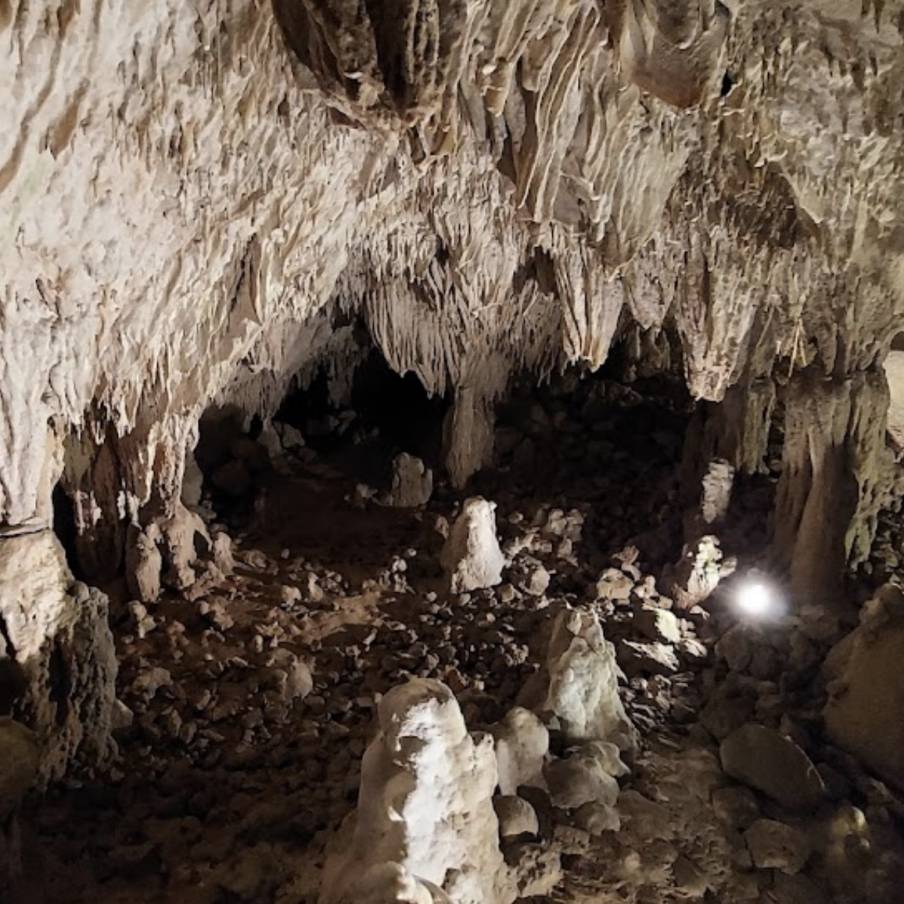
Romito Cave, discovered in 1961, is one of the oldest and most important prehistoric sites in Europe, that testifies the presence of man in the area since the Paleolithic period. It is located about 10 km from the village of Papasidero, near the gorges of the Lao River, in a landscape of caves and rock walls. The excavation campaigns brought to light important finds including the remains of a young hunter who lived about 17,000 years ago, three double burials of individuals, and many lithic and bone finds. Studies indicate that the site was frequented between 23000 and 10000 years ago. The most important discovery, however, is the "Bos primigenius" graffito, a rock carving depicting a prehistoric bovid, Aurochs, made with precise strokes, incredible respect for proportion and detail, and impressive depiction in perspective. The Romito Cave graffito is one of the most important examples of rock art of prehistoric times, making the archaeological site unique worldwide.
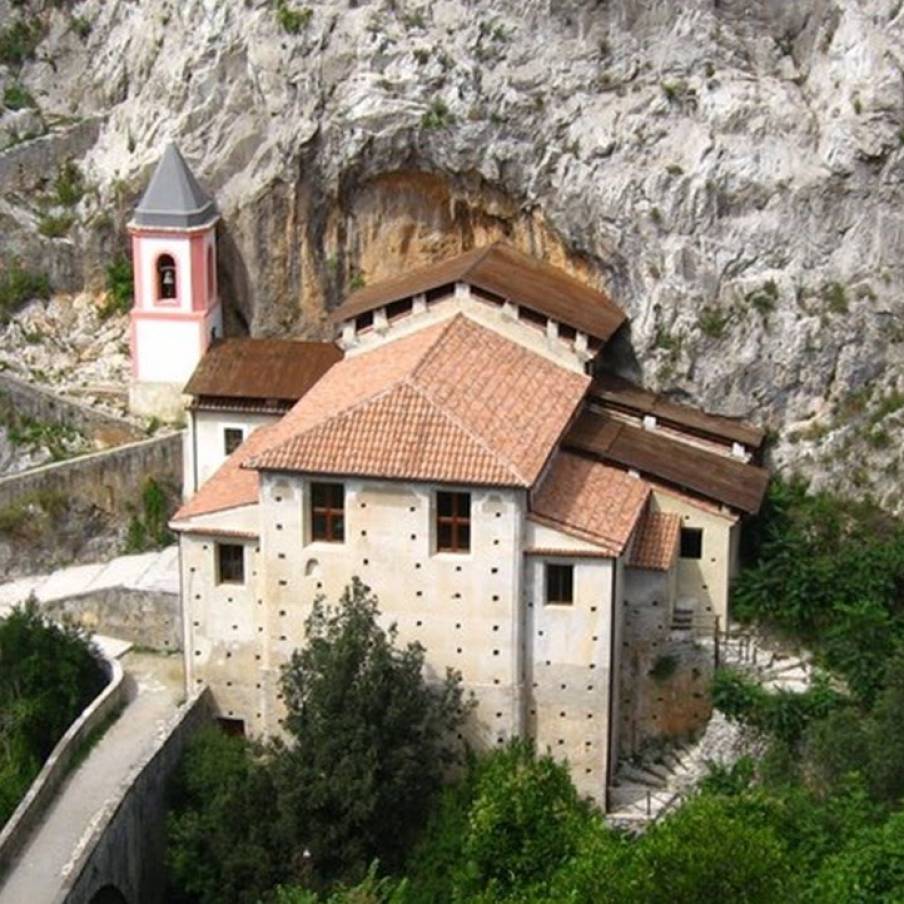
Cave church on the right riverside of the Lao, originally a late medieval "chapel," which took its present appearance between the second half of the 1600s and the early 1900s. With a Greek-cross plan, it has three naves marked by round arches. The patronal feast of the named after Madonna was introduced in 1679, in thanksgiving for her intercession at the time of the plague of 1656. Since 2002 the church has the status of diocesan shrine. Inside, on the central wall, stands out a large fresco by unknown artists, painted in various stages starting from the 17th century. It depicts the Madonna enthroned with the Child above whose head linger two crown-holding angels; on their right, a genuflected bishop (a metaphor of the triumphant post-Tridentine Church); on the left, the archangel Michael piercing the devil covered in flames (a symbol of the plague and Protestant heresy). The representation is surrounded by voluminous drapery alluding to the Virgin's protective mantle. (Edited by Xavier Napolitano)