PAPASIDERO VILLAGE DESCRIPTION
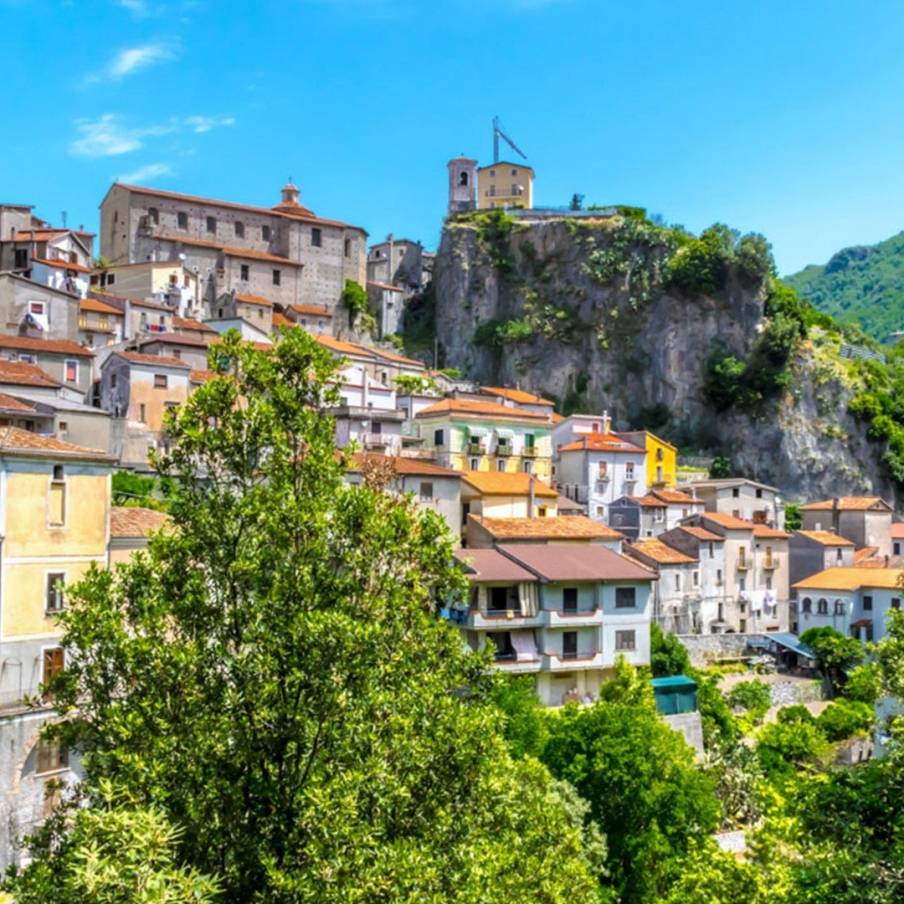
Papasidero, a village of medieval origin within the Pollino National Park, is a wealth of environmental and cultural treasures. It is located in the heart of the Lao Valley set on a spur of rocks and lapped by two streams, the Lao River and the Santo Nocajo stream. The origin of the village dates back to the 10th-11th centuries, a time when the presence of Byzantine monks in southern Italy was strong.
The village and its monuments are rich in references to the Basilian cult, which flourished and spread in this territory better known as "Mercurion." Papasidero, whose toponym refers to oriental origins, was one of the most important centers of the Mercurion and of the Greek-Byzantine cult of which ample evidence remain ample testimonies. The village, a small residential area, is rich of artistic and cultural beauty.
The surrounding landscape is extremely evocative, characterized by thick forests, cliffs and river gorges, crossed by ancient paths with bridges and stone steps from which you can see a lush nature. The historic center offers architectural gems such as the marvelous Sanctuary of the Madonna of Constantinople, set in the rocky cliff down over the Lao River; the ruins of the ancient medieval castle, which stand on the top of a cliff overlooking the town and the river; and the ancient walls that surrounded the town. In the municipality of Papasidero is the ancient village of Avena, now uninhabited, which offers a 360-degree view of the Lao River valley and the Orsomarso and Pollino Mountains. Of medieval origin too, it was the site of an ancient Basilian monastery founded by St. Leo-Luca of Corleone in the 10th century. But "History" in Papasidero goes even further back in time; one of the oldest evidence of homo sapiens of the whole Europe is located here: the Romito Cave, where primitive man more than 10,000 years ago lived and created a community.
The archaeological site, of worldwide importance, has within it a treasure of figurative art: the rock carving of "Bos primigenius," Aurochs, an ancient bovid perfectly carved on the rock, proportionate, made with a precise stroke and, amazingly, depicted in perspective. Romito Cave is an archaeological site of worldwide significance bearing one of the most important traces of the Paleolithic era.